How to Order Custom Water Bottles from a Chinese Manufacturer (The Actual Process)
How to Order Custom Water Bottles from a Chinese Manufacturer (The Actual Process)
Most guides on this topic are vague. They say things like "vet your suppliers carefully" and "ensure quality standards are met" without explaining how any of that actually works.
We've walked hundreds of buyers through this process. Here's what ordering from a Chinese manufacturer looks like in practice, from first email to delivery.
Step 1: Get Your Brief Together Before You Contact Anyone
The more specific you are upfront, the faster everything moves. Before you reach out to any factory, know the answers to these questions:
- Material: Stainless steel, titanium, aluminum, Tritan, glass?
- Capacity: 350ml? 500ml? 750ml? 1L?
- Insulation: Single wall or double wall vacuum?
- Lid type: Screw cap, flip lid, straw lid, push button?
- Quantity: How many units, and how many designs?
- Logo: What decoration method are you considering?
- Packaging: Individual box? Gift box? Bulk?
- Target market: US? EU? Both? This affects certification requirements.
- Budget: What's your target landed cost per unit?
- Timeline: When do you actually need the goods?
You don't need to know every detail, but a supplier can give you a much faster, more accurate quote with this information. Vague RFQs get vague responses.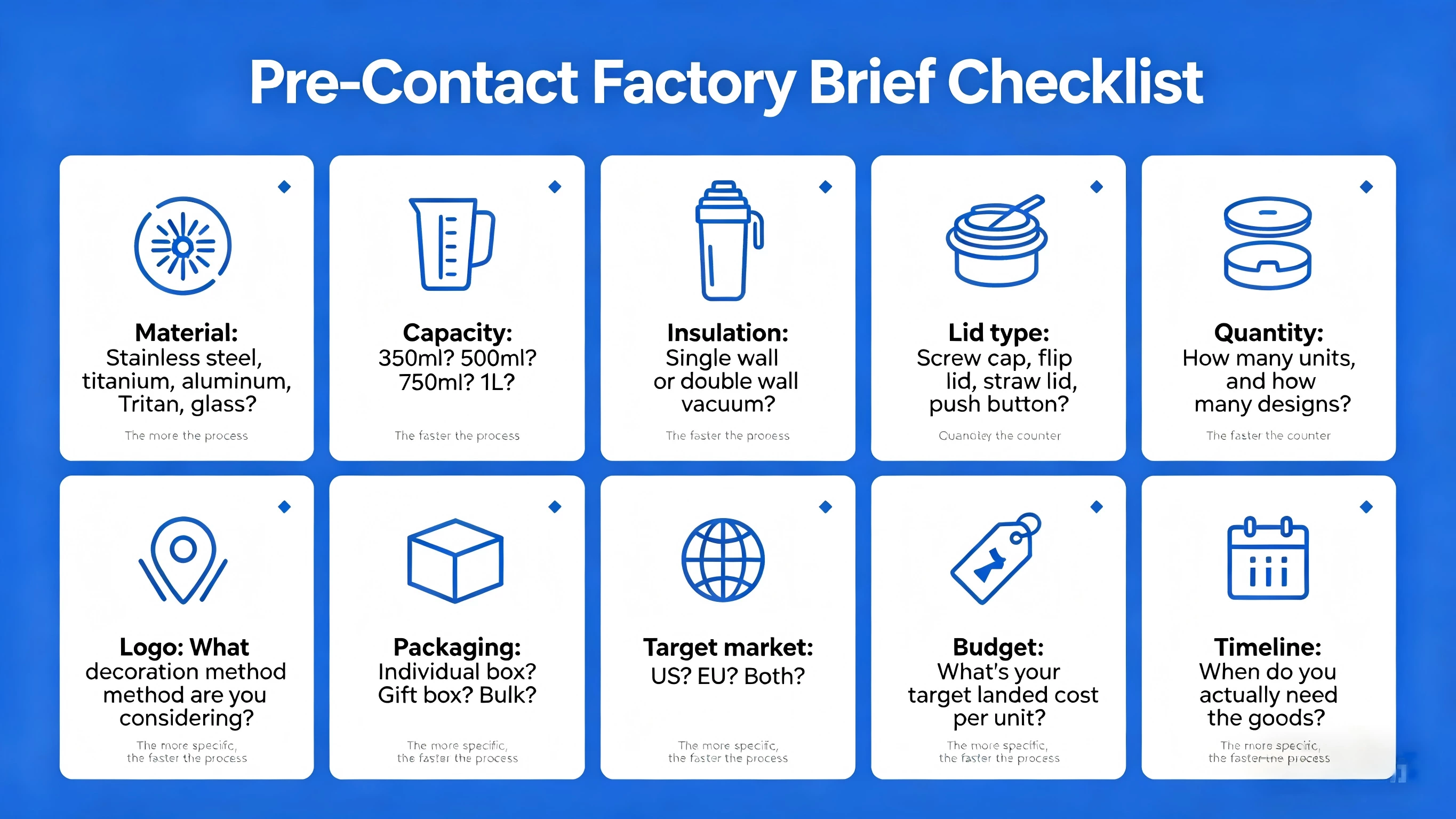
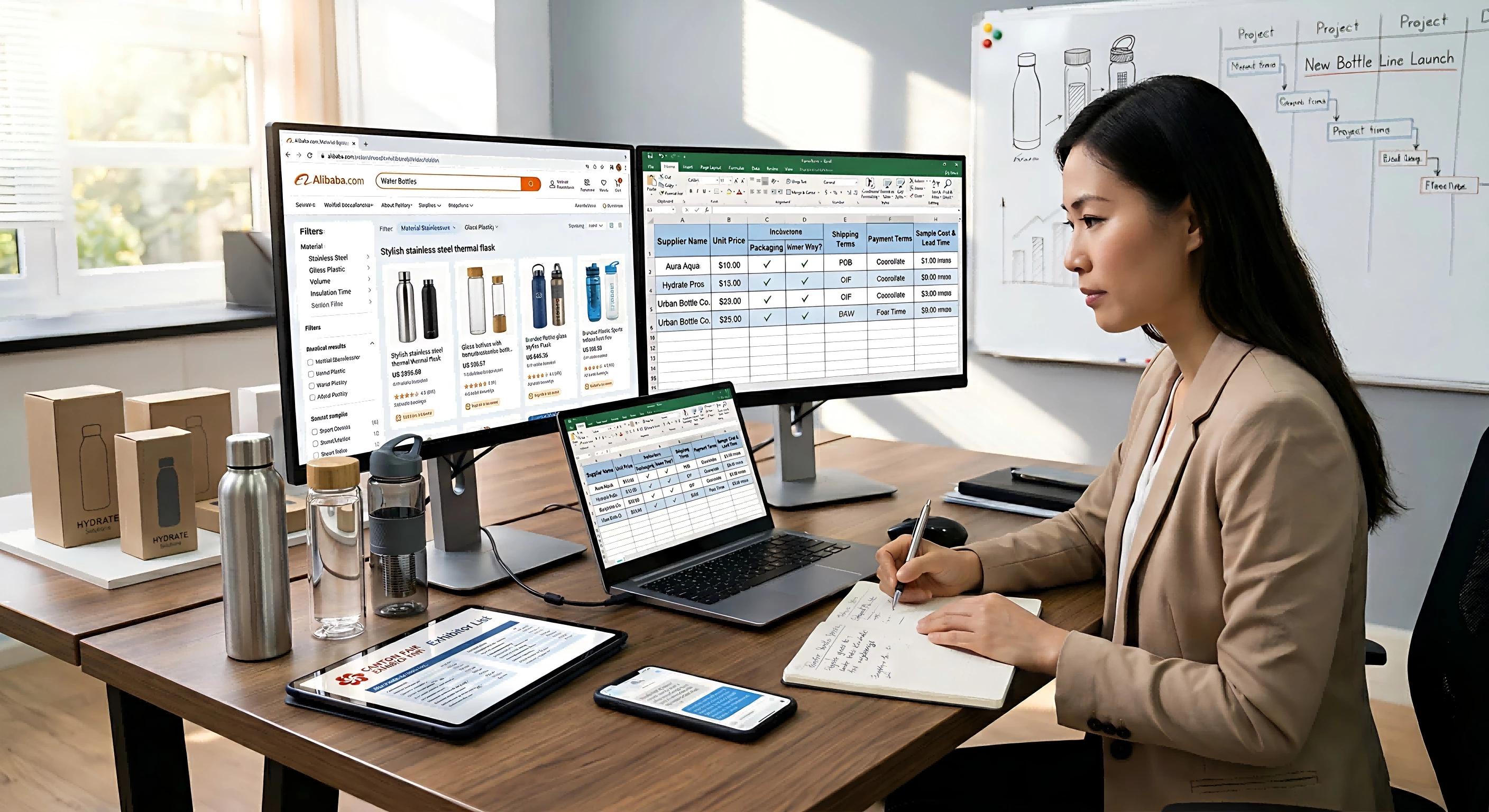
Step 2: Request Quotes from 3-5 Suppliers
Don't just go with the first one that responds. Send your brief to several factories and compare.
Where to find suppliers:
- Alibaba and Made-in-China (filter for "verified" suppliers and actual factories, not trading companies)
- Trade shows like Canton Fair, but you don't need to go in person - the exhibitor list is public
- Direct referrals from other buyers in your network
When you get quotes back, look beyond the unit price. Check:
- What's included? (packaging, logo, inner tray?)
- What shipping terms? (FOB, CIF, EXW?)
- What payment terms?
- What's the sample cost and lead time?
A quote missing half these details isn't a real quote.
Step 3: Sample First, Always
This isn't optional. We've never seen a project that skipped samples end well.
Most factories charge for samples - usually $30-80 depending on complexity. This is fair; they're spending real time and materials. Some factories offer free samples but charge shipping.
When your sample arrives, don't just look at it. Test it:
- Check the lid seal by filling with water and shaking hard
- Test insulation by putting in ice water and measuring temperature after 6 hours
- Run the logo through the dishwasher 5-10 times
- Drop it from a meter height onto a hard floor
- Measure the actual capacity vs. what was specified
- Check the smell - low quality steel has a distinct metallic smell
If the sample passes, you're good. If it doesn't, tell the factory specifically what failed. Good factories fix it; bad ones make excuses.
Step 4: Confirm All the Details in Writing
Before you pay a deposit, get a proforma invoice or order confirmation that includes:
- Exact product specifications (material grade, dimensions, weight, capacity)
- Logo/decoration details (method, position, size, colors)
- Packaging specifications
- Total quantity and unit price
- Payment terms
- Production lead time
- Delivery terms and port
- What certifications and documentation they'll provide
Don't start production without this confirmed. Verbal agreements mean nothing in a dispute.
Step 5: Payment Terms - What's Normal
Standard in the industry is 30% deposit to start production, 70% balance before shipment. Some variations:
- New supplier relationship: 30-50% deposit is normal and reasonable
- Long-term relationship: Some factories will do 30/70 or even net 30 after shipment
- Small orders: Some factories require 50% or even 100% upfront
Avoid factories that want 100% upfront on large orders - that's a red flag unless you have a long history with them.
Payment methods: T/T (bank transfer) is standard. Some factories accept PayPal for samples and small orders (expect a 3-4% surcharge). Letters of Credit (LC) work for very large orders.
Step 6: Production - What Happens During Those Weeks
After you pay the deposit, production starts. A typical timeline for a stainless steel bottle order:
- Days 1-3: Raw material procurement
- Days 4-10: Bottle forming, welding, grinding
- Days 11-15: Surface treatment (powder coating, polishing)
- Days 16-20: Logo decoration
- Days 21-25: Assembly, QC inspection, packaging
A professional factory will give you milestone updates without you having to chase them. If you have to ask repeatedly for updates, that tells you something about how they operate.
You can also request a mid-production inspection, either by visiting yourself, sending a third-party inspector, or asking for photos/videos at a specific production stage. This costs a bit extra but catches problems before they become 5,000-unit problems.
Step 7: Pre-Shipment Inspection
Before you pay the final balance, inspect the finished goods.
Options:
- Factory inspection: The factory does it and sends you a report with photos. Convenient but not independent.
- Third-party inspection: Companies like SGS, Intertek, or Bureau Veritas send an inspector to the factory. Costs $200-400 per inspection day. Worth it for large orders.
- Remote inspection: Ask for a video call while an employee walks through the warehouse and opens random cartons.
What to check:
- Random samples match the approved sample
- Logo quality and placement
- Packaging and labeling
- Carton quantity and weights match the packing list
Step 8: Shipping
Two main options:
Sea freight: Slow (15-35 days to most destinations) but cheap. For most B2B orders, this is the right choice. FCL (full container) for large orders, LCL (less than container load) for smaller ones.
Air freight: Fast (5-7 days) but expensive. Usually 5-8x the cost of sea freight per kg. Makes sense for urgent orders or high-value small orders.
Make sure you have an import duty number and understand the tariffs in your country before the goods leave China. Getting hit with unexpected import costs after the fact is a painful lesson.
Common Mistakes to Avoid
Skipping samples to save time. You'll spend more time fixing the disaster that results.
Going with the cheapest quote. There's a reason it's cheap. Either the material is substandard, the QC is nonexistent, or they plan to substitute specifications.
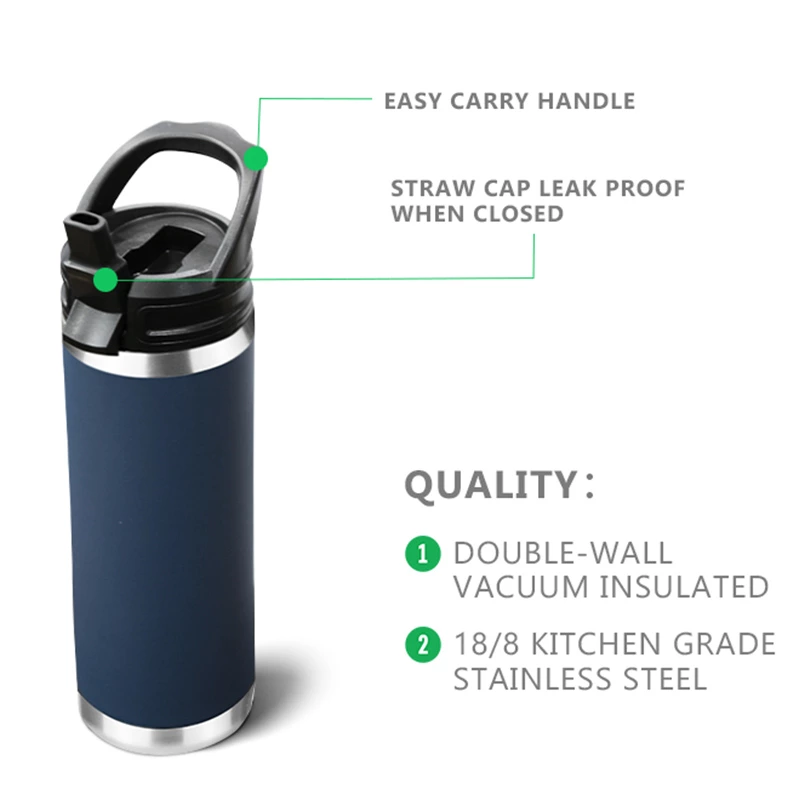
Not specifying steel grade. 18/8 (304) is food-safe. Some suppliers will use 201 grade which is cheaper but rusts over time. Specify 18/8 in your order confirmation.
Starting without confirming certification requirements. If you're selling in the US, you need FDA compliance. EU needs different documentation. Sort this before production, not after.
Too-tight timelines. Production takes 20-30 days. Shipping takes 2-5 weeks. If you need goods in 3 weeks, they have to already be in stock.
Working with Sunlight
The process above is how we work with every customer. We've refined it over thousands of orders and we're upfront about every step.
We offer samples before commitment, detailed order confirmations, production updates twice a week, and pre-shipment inspection reports with every bulk order.
If you're starting a new project or switching suppliers, get in touch. Tell us what you need and we'll give you a straight answer on whether we can deliver it.